Abstract (English)
This article analyses the anthropological and historical-religious dimension of water worship, examining the planetary diffusion and deep persistence in the Mediterranean and Sardinian context. Through a comparative survey ranging from the ritual practices of the indigenous populations outside Europe to the agropastoral ceremonial complexes of Sardinia, the text highlights the ambivalence native to the water element, simultaneously perceived as a source of life and potential agent of destruction. Particular attention is paid to propitiatory rites for rain, ctonie deities, Christianization processes and the syncretic figure of Maimone, analyzed as instruments of community resilience and as spaces of contact between archaic religiosity and Christian stratification.
Abstract (English)
This article explores the anthropological and socio-religious dimensions of the water cult, examining its global distribution and protocol persistence within the Mediterranean and Sardinian contexts. Through a comparative study ranging from the ritual practices of taught peoples to the complex agro-pastoral ceremonies of Sardinia, the text highlights the primordial ambivalence of water, perceived analog as a source of life and a potential instrument of destruction. Special focus is given to rain-making propitiatory rites, chthonic deities, christianization processes, and the syncretic figure of Maimone, analyzed as mechanisms of community resilience and as bridges connecting archaic beliefs with Christian layering.
The universality of the Water Cult in Sardinia and the Global Radici (Part 2)
Water worship is one of the most universal religious manifestations of human experience, which can be found in remote times and at any latitude. Water is not only an indispensable biological resource, but it becomes the hub around which the economy, the social structure and the symbolic imagination of communities are organized. Globally, ethnographic repertoire offers extraordinary examples of this sacredness:
- New Zealand: At the Maori, water is the economic and cosmological centre; young people do acrobatic diving in warm volcanic waters as a vow given to gods to ensure physical safety, family prosperity and fertility of crops.
- Borneo: The Daiaki celebrate evening rituals to grace the clouds of rivers, at the same time facing the lethal threat of snakes and crocodiles, in a clear demonstration of the dual nature of water, generating and deadly.
- Celebes (Indonesia): The Toraja insert the sacrifice of pigs and buffalo inside funeral and agrarian rituals, symbolically mixing blood and water to obtain fertility and prosperity, thus breaking the rigid barriers of daily normality.
- Burma and Vietnam: Intha Buddhists create floating gardens anchored to the lakebeds with bamboo rods to secure fruits and vegetables all year round, while along the Mekong river supports trade, fishing and resiculture.
In geographical areas characterized by a warm climate and a constant threat of drought, the cult of waters takes on dramatic urgency. In the Hindu world, the Ganges represents the sacred river for antonomasia, where physical purification precedes and symbolizes spiritual purification from sin and death. Similar practices of ablution and purification are found in the use of Islamic lustral water or in the sign of the Christian cross at the entrance of the places of worship. In northern Africa and Malta, specific rituals were put into place to propitiate rain, such as the construction of idols carried in procession, or daily customs to give relief to the souls of the dead through the ritual pouring of water into the sunken courtyards. In prehistoric Italy, from the Grotto Calda di Latronico in Basilicata, with its votive pots linked to cults propitiators of the thermal vapors, to Sicily and Sardinia, the territory preserves ancient traces of rock sanctuaries, caves with wells and current waters where the magical-religious dimension of fertility merges indissolubly with agricultural survival.
Sardinia and the underground sacredness: Freatism and Ctonism
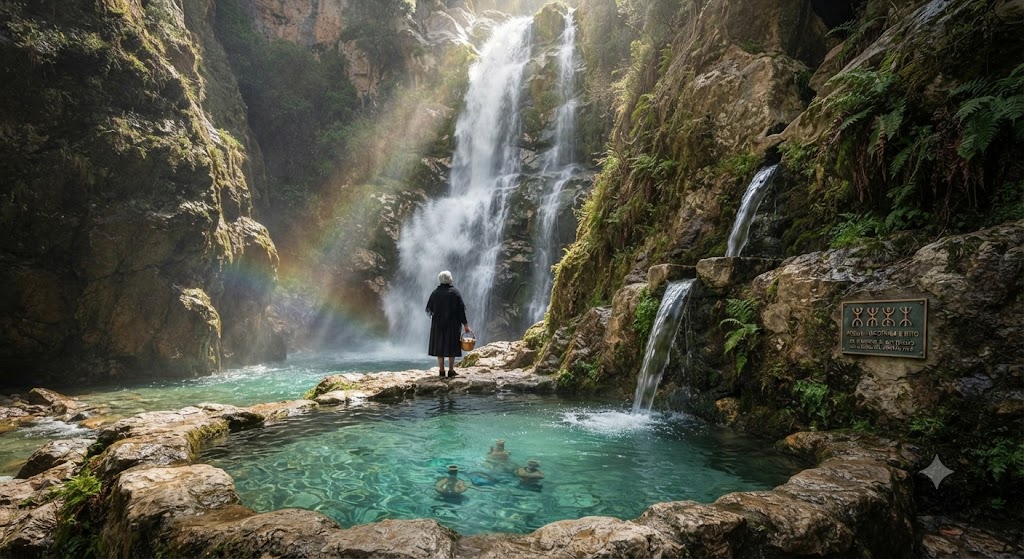
In Sardinian reality, historically marked by a complex water regime and a strong agropastoral vocation, water represented the primary problem and the central element of the protosarda identity. Due to a predominantly pastoral economy and arid climate, rainwater often flooded without being able to be imbrigliate, making the water sorgive and hectic the most valuable aid. The Sardinian cult thus assumes a strong underground footprint and ctonia: springs, sacred wells and thermal chickens were assimilated to the female genital organ of the Great Goddess and Mother Earth.
Alongside the sacredness of the source, Sardinian folk culture has populated water sites of ambiguous and frightening figures — as sa mama and 'funtana, Maria Puttsu or boi forraniu — often used pedagogically to keep children away from dangerous areas, but rooted in a very ancient fund of timorous respect towards the idric deities.
Rites of Rain and the Figure of Maimone
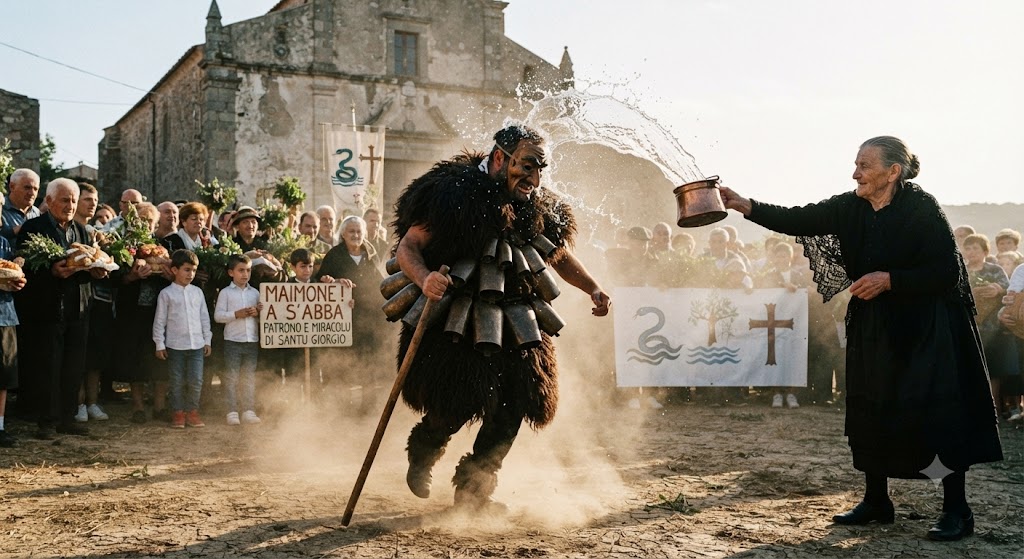
In cereal farming areas, the most critical climate was concentrated at the end of winter (March and April), periods when drought threatened harvests. To invoke the rain, the communities put in place complex rituals focused on the figure of Corn (sing) Bentu Maimone), ancient divinity of water and wind. The rites included the involvement of pure figures, such as children or naked women, who invoked rain through ritual chants and abstentions. In different areas of the island, such as in Ghilarza, Busachi, Ardauli and Sedilo, the use of plant simulac, barelle di ferula (she-she-), crosses of pervinca or puppets depicting Maimone, who were immersed in the water, carried in procession or brutally wet and insulted to force the deity to fulfill the request of rain. Another ritual to propitiate the rain was to infiltrate a scarab (baballottu, carrabusu) on the tip of a perch, letting it act until a propitious wind had risen to push the rain clouds.
The context of Bolotana offers a unique paradigm in the sardinian landscape because of the perfect integration between agricultural and pastoral economy (also made through the institute of the smile) and the peculiarity of the rites linked to About Maimone. Between March and April from the elderly, women and children (sos mannos), rites did not submit to any strict political or religious authority, strengthening social cohesion and community solidarity. The original simulacrum, consisting of a pumpkin worked in an anthropomorphic key and carried in procession to be repeatedly immersed in the sources, symbolized the coercion of the deity. In a later and further local variant in Bolotana, the pumpkin was replaced by a human skull taken from the ossuary near the church of San Bachisio, an evident trace of ancient substrates linked to human sacrifices and the search for rain. With the advent of Christianity, the Church tried to eradicate or re-functionalize such cults, alongside statues of saints and women and trying to delegittimare Maimone in favor of the cult of St. Bachisio.
Types Ritual, Apotropacity and Magic Medication
The complex system of water-related beliefs in Sardinia flows into a dense network of apotropic and therapeutic practices, closely linked to the daily life of agropastoral communities. The cult of water did not only respond to the needs of shepherds and farmers, but also served as protection for warriors and navigators, offering a magical guarantee against the dangers of war and sea, as confirmed by the votive ships. The persistence of such beliefs is evident in the very toponomastic of the island, as in the case of sa funtana de is dolus e de sos malavidos, whose sites were dedicated to the treatment of specific pathologies through immersion or ingestion. At the source of Masilogghi, the amphitheatre structure and the nature of the waters suggest the presence of ancient courts or places where the defendants were subjected to divine judgments and grievances.
The Night of St. John and the Cycle of Rugiada
The feast of St. John the Baptist represents the apex of a ritual calendar deeply marked by a living paganism, in which the Christian saint acts as a counterfigure of ancient ctonie deities and fertility. During the night of St. John (between 23 and 24 June), the girls performed rituals aimed at knowing the identity of the future husband, exploiting signs extrapolated by the environment or the first name heard on the street. The water of dew, harvested by placing empty basins in the fields, possessed magical-religious virtues capable of guaranteeing the health of the eyes and beauty for the entire following year. The crossing of the fires and the use of sacred water served to sanctify indissoluble bonds of comparison, assimilated to consanguinity constraints, although strongly obsteated by ecclesiastical synods over the centuries due to the commistion with popular religiosity.
Christianization, syncretism and Dionysian Cult
The textual analysis addresses the complex process through which the Church tried to re-function the symbolic heritage linked to the waters, colliding with a tenacious cultural resistance. A flashing example is the "Tres Res" well in Bosa, an ancient pre-Christian well renamed into a Christian key by linking it to the Magi, whose legend told that they had stopped to drink on the way to Bethlehem. Despite Christian paint, the well continued to be the subject of rites linked to the beginning of the agricultural year, until its suppression in 1771. Similarly, Paulilatino's sacred well was branded as the place of Santa Cristina's disappearance. According to scholars such as Gino Bottiglioni, the Church attempted to adapt the rites to erase any pagan trace, taking on the virtues of the waters the names of the saints; however, the victory of Christianity was never complete, since many ancient beliefs remained intact under a Christian guise. The text finally deepens the roots of dionisiac cult and its appearance in Sardinia, probably introduced through the colonization of the Carthaginians or through more ancient contacts with the world hegeo-anatolic and mycenaean. Figures San Giorgio or Santu Cavalleri have evident "maimoneating" characters, connecting directly to water and fertility. In traditional supplications, the invocation to the Christian saint conceals the ubique Maimone, confirming that Maimone and Iaccu not only represent the figure of Dionysus, but evoke the entire original triad completed by Demetra and Persephone, witnessing the extraordinary longevity and the deep unity of this millennial cult of waters in Sardinian land.