Abstract (English)
The present monograph investigates the origins, anthropological profile, linguistic substrate and historical coordinates of the populations who inhabited Sardinia in prehistoric and protohistoric times, before and during the culmination of the nuragic civilization. Through the comparative analysis of osteological data, fossil toponomastics and early lexical wrecks, the study examines the extraordinary biological and cultural resilience of the Mediterranean island. Particular attention is paid to the structural affinities between the paleosardo and the spoken preindoeuropee, with specific reference to the Basque and Iberian world, highlighting the ethnic dualism between mountain shepherds and coastal communities exposed to phenician-punic and Roman influences.
Abstract (English)
This monograph investigates the origins, anthropological profile, linguistic substrate, and historical coordinates of the populations inhabiting Sardinia during the prehistoric and protohistoric periods, before and during the height of the Nuragic civilization. Through the comparative analysis of osteological data, fossil toponymy, and Paleosardinian lexical relics, the study examines the extraordinary biological and cultural resilience of this Mediterranean island. Special attention is devoted to the structural affinities between Paleosardinian and pre-Ind-European idioms, with specific reference to the Basque and Iberian worlds, highlighting the ethnic dualism between highland pastoralists and coastal communities exposed to Phoenician-Punic and Roman influences.
The puzzle of the origins
Who were the nuraghi builders? Responding to this question requires me to combine anthropological, linguistic and ethnographic elements. There is no clear separation between the Proto-Sardinian Fund and the populations arrived later (fenician, punic and Roman), since the island has experienced a continuous process of cultural and biological absorption. The exceptional resilience of the insulating environment allowed the survival of unique linguistic fossils and somatic traits in the Mediterranean.
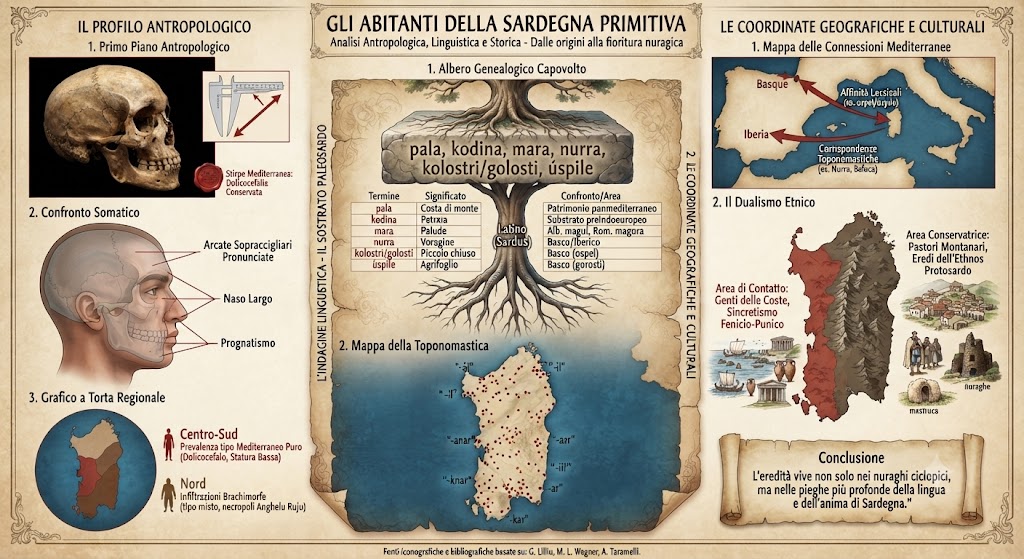
Prehistoric and protohistoric skeletal remains show a strong affinity with today's Mediterranean types. Dolicocephaly is widely attested especially in central and southern areas (Sardara, Mogoro, Seulo), where low statures (1,55-1,60 m) and "protomorphic" characters (arched pronounced eyebrows, prognatismo). In the North (Anghelu Ruju) brachycephale infiltrations appear. To grasp the true specificity of the primitive Sardi, however, anthropology must be accompanied by the linguistic investigation.
The study of lexicon and toponomastics not explainable through Latin, Greek or punica reveals an ancient indigenous heritage. Terms related to nature and territory (as palate, kodina, mara, nurra) show an extraordinary persistence in Sardinian dialects. Fonetically, the paleosard distinguished itself by the frequency of initial words in vocals, the absence of $$ initial and a strong vocal harmony.
From the morphological point of view, the paleosardo has characteristic endings (as - yeah, - yes, - the, -anar). This language does not show ties to the Semitic or Indo-European world, but is part of the pre-European Mediterranean substrates. Strong are the structural and toponomastic analogies with ancient Iberian and, in particular, with the Basque language (e.g. nurra, ùspile, kolosters).
The history of ancient Sardinia highlights a persistent dualism: on the one hand the coastal and agricultural communities most exposed to external influences, on the other the shepherds of the indoor mountainous areas, jealous guardians of their independence and ethnic tradition. This dualism reflects the complex cultural stratification of the island from protohistory.
In its deepest nucleus, the paleosarda population connects with the primitive Mediterranean lineages similar to the Iberian prelatini and the Basques. The legacy of this ancient world survives not only in the imposing nuragic structures, but in the very heart of the language and culture of Sardinia.