Abstract
This essay analyses the historical-religious roots of ancient Sardinia through the two fundamental archetypes of the agropastoral and nuragic world: the Great Mother (Mediterranean Mater) and the Taurus God. Archaeological, monumental and anthropological sources related to the worship of the goddess, associated with the fertility of the earth, the waters and cycles of life and death, as evidenced by the contexts of the Domus de Janas and the well-built temples like Santa Cristina. At the same time, the figure of the Taurus God is deepened, symbol of generative power and protector of the dead, witnessed by the bronze protomes and depictions in the prenuragistic and nuragic funeral structures. The analysis highlights the coherence of a cosmological and social system originally matriarchal, founded on the balance between female and male principle, whose traces survive in the rituals and intangible heritage of the island.
General
This ity analyzes the historical and religious roots of ancient Sardinia through the two fundamental archetypes of the agropastoral and Nuragic world: the Great Mother (Mediterranean MaterAnd the Bull God. It examines the archaeological, monumental, and anthropological sources related to the cult of the Goddess, associated with the fertility of the earth, waters, and the cycles of life and death, as evidenced by the contexts of the Domus de Janas and well temples such as Santa Cristina. Concurrently, it explores the figure of the Bull God, a symbol of generative power and protector of the dead, attested by bronze protomes and representations in pre-Nuragic and Nuragic funerary structures. The analysis highlights the coherence of a cosmological and social system with an originally matriarchal imprint, based on the balance between the female and male principles, traces of which survive in the island's rituals and intangible heritage.
The analysis of the religious and anthropological roots of ancient Sardinia requires careful reconnaissance of material testimonies and founding texts describing the spiritual substrate of the island. Within the Mediterranean landscape, Sardinian civilization has preserved an autonomous cultural physiognomy, deeply rooted in an agropastoral context where sacredness was expressed through the indissoluble bond with natural elements, land, water and wildlife and domestic. At the centre of this symbolic system are the figure of the Great Mother, or Mediterranean Mater, and his male counterpart, identified with the Taurus God. These two entities not only represent two distinct deities, but constitute the poles of a coherent cosmological system, aimed at explaining and propitiating the eternal cycle of life, death and regeneration. The examination of archaeological, monumental and textual sources allows to outline the complexity of these cults, highlighting how they shaped not only the sacred architecture of the Bronze Age, but also the social structure and the collective imagination of the island through the millennia.
The Mediterranean Mater and the Mystery of Primordial Fertility
The cult of the Great Mother in Sardinia has its roots in a remote past, before the nuragic age, and permeates the entire Mediterranean basin with a dense network of iconographic and cultual remains. In the collective imagination and archaeological research, the definition of this deity collides with the complexity of its manifestations, since the numerous fictitial, lithic and rock reproductions do not offer a unique interpretative key, leaving open the debate on the real identity and the original function of these figures. Nevertheless, it is widely recognized that the Goddess Mother represented the highest female deity of the island, venerated since the pre-nuragic period in close connection with nature, forests, rainfall and water sources. This association with vital elements justifies the typical iconographic representation of a female figure with generous and abundant forms, conceived as a primordial and generating mother, whose creative force is assimilated to the earth itself.
The fertile land, in fact, welcomes the dry and apparently dead seed to return it, through the cycle of the seasons, in the form of a new sprout. This agropastoral metaphor is also reflected in the funerary sphere. In many Sardinian archaeological contexts, the reproductions of Mediterranean Mater were found inside hypogeic necropolis, such as the famous Domus de Janas. Within these burial structures carved into the living rock, the deceased were laid in fetal position, symbolically imitating the return to the mother's womb. This practice highlights a conception of death not as an absolute end, but as a phase of transition and expectation of a new birth, comparable precisely to the seed that rests in the subsoil to regenerate. This cyclical vision of life finds its extraordinary monumental materialization in sacred wells and in megaron temples dedicated to water, where architecture itself dialogues with celestial and telluric cycles.
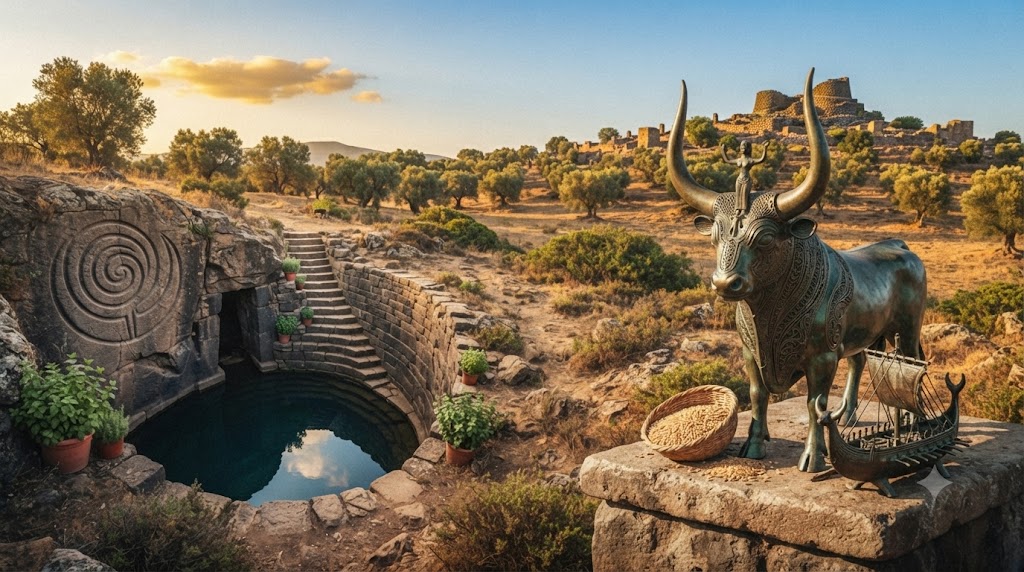
An emblematic example of this synthesis between sacred architecture, water worship and astronomy is represented by the Pozzo di Santa Cristina. In this hypogeic temple, characterized by a monumental entrance in the form of a triangle that recalls the pube and the biological origin of life, a wise fusion of geometry and celestial observation is manifested. According to the analysis of some scholars, in fact, every eighteen and a half years the moon, considered one of the possible physical manifestations of the Great Mother, mirrors perfectly in the deep waters of the bottom of the well, sealing the bond between the heavenly vault, the earth and the underground fecundity. This dense plot of symbolic correspondences was accompanied, according to the hypothesis of numerous anthropologists, to an ancient social structure of matriarchal mold. This cultural matrix would have imprinted a peculiar character to Sardinian society, in which the female figure has never been confined to roles of secondary importance, distinguishing itself clearly from the patriarchal models prevalent in other civilizations of the ancient world and leaving a lasting imprint in customs and local sensibility.
The Taurus God and Sacred Masculineity in the Nuragic Substrate
Complementary and subordinate to the figure of the Great Mother, although endowed with an autonomous force and of equal cosmological dignity, is the figure of the Taurus God. Animal symbol of physical power, vigor and fertility, the bull embodies the fruitful force of nature, in close relationship with the productivity of the earth and with the cycle of water. In a civilization such as the nuragic one, whose economy was founded mainly on agropasto-ralism and the exploitation of mineral resources, the taurine deity represented the male generator principle, indispensable to guarantee the prosperity of the crops and the survival of the community. Precisely by virtue of this connection with the vitality of the earth, the consort of the Great Mother was deemed to reside also within the sources, streams of water and sacred wells, places where the liquid element encountered rock and soil fertility.
However, the presence of the Taurine cult in Sardinia is not limited to the sphere of agrarian fruitfulness, but extends its range of action to the world of the dead and to the outer protection. In the material testimonies found in the temples and funerary contexts of the island, Taurine protomes frequently appear in the form of votive sculptures in bronze and terracotta. The bull is depicted as a male god protector of the dead, whose image is engraved on the walls and on the entrance stones of the Domus de Janas, painted in underground graves or carved in betiles and menhirs, that is the fixed stones of a phallic character symbolizing the perennial virility of the male god. This dense concentration of taurine symbols in burial places shows how the figure of the bull acts as a guide and guard in the difficult passage from earthly to outer existence, confirming the dual valence of divinity, linked both to the generation of life and to the safeguard of cosmic order after death.
On the level of historical and cultural influences, the cult of the Taurine god in Sardinia has stimulated wide academic debates about possible contacts with the Greek and Eastern civilizations of the ancient Mediterranean. Some scholars have hypothesized a derivation of this ancient Sardinian deity from the Egyptian god Api, also characterized by taurine appearances, or interpreted such analogies as the fruit of a mutual and profound cultural influence between the Nilotic civilization and that of the Shardana, the warrior population protagonist of the Sardinian and Mediterranean history of the Bronze Age. Regardless of the flows of external exchange, the figure of the bull in Sardinia has maintained a strongly autochthonous physiognomy, able to settle in the collective unconscious of the island and to re-emerge, in the following centuries, through a series of ritual survivals that testify the extraordinary resilience of the ancient pagan beliefs in front of the advent of Christianity.
Bibliographic notes and references
- On the overall analysis of the prehistoric and protohistoric religious substrate of Sardinia and the conception of the funeral and sacred space, we refer to the fundamental archaeological synthesis of Giovanni Lilliu, in particular The Sardinian civilization from paleolithic to the age of nuraghi, Torino, ERI Editions, 1988, pp. 115-142.
- For a specific study on the symbolism of water, the architecture of sacred wells and the relations with megalithic astronomy on the island, see the contributions of Arnold Lebeuf and editions related to Sardinian astronomical archaeology, in particular regarding the site of Santa Cristina di Paulilatino.
- On the dynamics of the original matriarchate and on the persistence of female roles in traditional Sardinian culture, see the anthropological treatment of Dolores Turchi, Masks and myths of Sardinia, Roma, Newton Compton Editori, 2014, pp. 45-62.