Abstract (English)
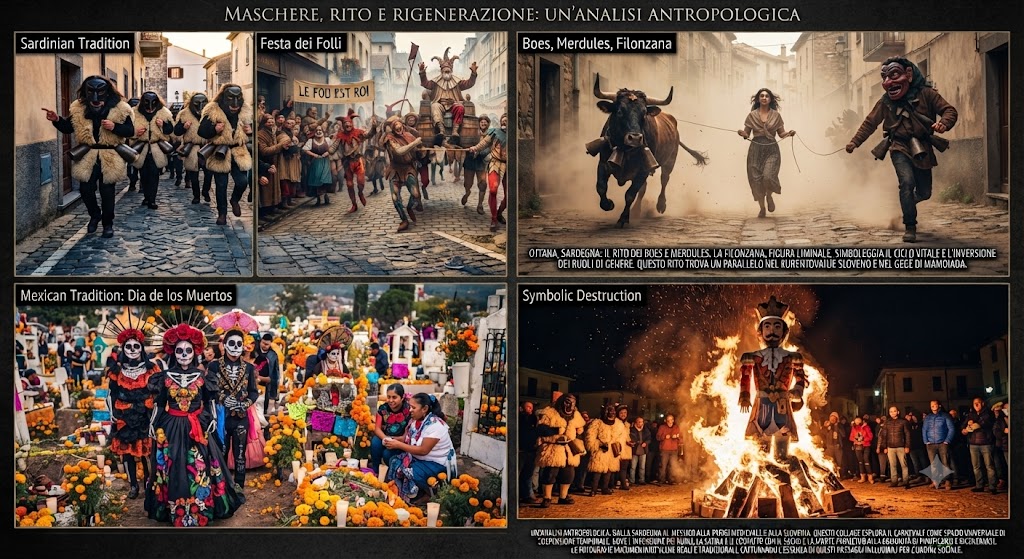
The present reflection analyses the Carnival and traditional rituals not as simple moments of leisure, but as complex spaces of temporal suspension, transgression and community regeneration. By comparing the extraordinary variety of Sardinian Carnival — from the agropastoral rituals of Barbagia (with Mamuthones and Merdùles) the equestrian sacredness of Sartiglia of Oristano, up to satire and to the rogue of fans as King George in Tempio Pausania and Joy in Bosa — with the Carnival and the cult of the Mexican dead and with the historical Feast of the Folli of medieval Paris, the study highlights a universal common denominator: masking and rite as instruments of metamorphosis and contact with sacred and death. Through the reversal of roles, corrosive satire and symbolic destruction of the established order, each of these traditions absolves to the same anthropological function. The temporary break-up of the rules and the dive into the chaos of the mask thus proves ineludible passages so that the community can purify itself, exorcize adversities and ensure its cyclic regeneration.
Abstract (English)
This ity examines Carnival and traditional rituals not taught as moments of entertainment, but as complex spaces of temporal suspension, transgression, and community regeneration. By comparing the extraordinary variety of Sardinian Carnival traditions—ranging from the agro-pastoral rites of Barbagia (featuring the Mamuthones ♪ Merdùles) and the equestrian sacredness of Oristano's Sartiglia, to the satire and burning of effigies like King George in Temple Pausania and Joy in Bosa—with Mexican Carnival and Day of the Dead customs, as well as the historical Feast of Fools in medieval Paris, the study highlights a universal common denominator: masking and ritual acting as tools of metamorphosis and communion with the sacred and death. Through role reversal, biting satire, and the symbolic destruction of established order, each of these traditions fulfills the same anthropological function. The temporary breaking of rules and the immersion in the chaos of the mask evidence to be essential steps enabling the community to purify itself, exorcise adversity, and ensure its cyclical regeneration.
Carnival has never been a mere moment of leisure or cheerful ephemeral. Since its most remote roots, which sink into the Roman Saturnals and the agrarian cults of propitiation of the earth, it is configured as a suspended temporal space — a real "time out of time" — in which the laws of the community turn, the constituted order is temporarily suspended and transgression becomes law.
Analyzing traditional Sardinian texts (from the archaic masks of Barbagia to the equestrian rites of Oristano, to the bourgeois satire of Temple) emerges with force a universal common denominator: masking and rite as instruments of metamorphosis, social subversion and contact with sacred, fertility and death.
This essay explores these dynamics, comparing the Sardinian Carnival with two extraordinary traditions for symbolic and psychological affinity: the Mexican Carnival (and the famous De los Muertos) and historical Folli Festival (Fête des Fous) of medieval Paris.
La Sardegna: From Barbagia to Sartiglia and the Foundation Rites
In the Sardinian world, the Carnival declines in deeply different souls but united by the same archaic conductor: the earth, the cycle of life and the control of natural forces.
- The Agro-Pastoral Rites of Barbagia: Come on Mamuthones and Insokotadores by Mamoiada to Merdùles and Bòs by Ottana, up to ♪ by Orotelli, the zoomorphic mask and the heavy burden of the bells mark the primordial struggle between man and beast, the domain on winter adversities and the hope for the fertility of the fields.
- The Sartiglia di Oristano: It is one of the most spectacular and complex equestrian rites of the Mediterranean, organized by the ancient flocks of peasants and hawks. In the middle there is the figure on compositions, an androgynous being invested with an almost divine sacredness after the rite of dress (during which it cannot touch earth). The race to the star and the final blessing with sa pippia'e maju (double bouquets of violets and mammoles) represent a powerful propitiatory ritual of fertility and abundance, heir of ancient trials of dexterity and passage.
- The Carnival of Tempio Pausania and Bosa: In Temple the feast is dominated by the figure of King George (King Ghjolghu), an hedonist and maid monarch who is tried, condemned and solemnly burned in the square at the end of fierce allegorical parades. In Bosa, the Karrase explodes in its most spontaneous and firey form with Joy and the songs of Laldinglu, in a treachery of sharp satire and allusions to the sexual and vital sphere.
Carnival and Day of Death in Mexico: Mask as Family with the Over
If the Sardinian Carnival uses the equestrian ritual and the zoomorph disguise to propitiate the land and dominate the chaos, the Mexico brings this connection with cosmic cyclicity to a level of unique cultural fusion, heir of the synthesis between mesoamerican cosmology and catholicism.
- The Coating and the Catrina: In the Mexican context, especially during De los Muertos, the skull and the mask do not generate fear. The famous Calavera Catrina and the faces painted to skeleton reiterate a conception of death not as an absolute end, but as a necessary phase of life, just like the stake of King George or the sacrifice of the puppet in Sardinia aim to spring rebirth.
- Rovesciamento and Satira: Similarly to the Bosnian satirical chants or to the contestation of the power typical of Sardinian popular classes (as sa pannette or on doctors in the carnival of Cagliari), the Mexican Carnival uses ferocious satire to zero social distances. For a day, the poor wears gifts clothes and authorities are desacrated through collective laughter.
- The Propitiation of Life: How on compositions in Oristano opens the door to the prosperity of the community through the race to the star, Mexican parties mobilize the whole community around the domestic altars and squares to ensure the continuity of the bond between generations and nature.
The Folli Festival in Paris: The Ecclesiastical Subversion of the Middle Ages
In the heart of medieval France, and in particular in Paris and the great cathedrals Folli Festival (Fête des Fous) represented the urban and ecclesiastical equivalent of carnival chaos. Celebrated in January, this holiday saw the low clergy completely subvert the ecclesiastical hierarchy.
- The Pope of the Pazzi: A "Papa dei Pazzi" was elected, which officiated parodistic liturgies, recited extravagant masses, burned old soles of shoes in the incense instead of incense and transformed the sacred space into a theatre of overthrow.
- Theology of Rovesciation: This desecrating practice reflected the belief that the social and ecclesial order needed a periodic "flap valve". To allow the latter to command and roam the powerful prevented the violent breakup of the order, channeling tensions into a collective catarsis.
- Parallelism with Sardinia and the Latin World: Just as in Sardinia the carnival represents a "constant resistance" — a way to defend the right of the community to use its own time and identity against external impositions — the Feast of the Folli allowed the people and the low clergy to temporarily reappropriate their voice through the mask and authorized madness.
Comparative Table of Traditions
| Size | Sardinian Carnival (Barbagia, Oristano, Tempio, Bosa) | Carnival and Holiday in Mexico | Folli Festival (Medieval Country) |
|---|---|---|---|
| Main function | Agricultural/Equestrian (Sartiglia), exorcism of death, cyclical transition and social satire. | Cult of ancestors, acceptance of death as a vital cycle, political and social satire. | Exploitation of social/clerical tensions, temporary reversal of authority and hierarchy. |
| Nature of disguise | Wooden masks (♪), animal skins, wax masks and lace veils (Sartiglia), noble or grotesque clothes. | Skeletons (calaveras), traditional colored dresses, zoomorphic figures. | Talousar dress worn on the reverse, vests, grotesque masks and liturgical parodies. |
| Subversive element | Inversion servo-master, verbal lynching, rogue of the kings/fantocks and satirical processions. | Criticism of ferocious politics, derision of death and bourgeois institutions. | Deseccrating parody of ecclesiastical hierarchy and papal ceremonial. |
| Summary | Process and Rogo of the puppet (King George, Joy) or closure of equestrian rides (Sartiglia). | Offers to domestic altars, community celebrations in cemeteries. | Return to the liturgical and hierarchical order after the feast. |
Conclusions
The comparison between the mosaic of Sardinian carnivals, Mexican traditions and the Feast of the Parisian Folli shows how humanity has constantly felt the need to institutionalize chaos to preserve order.