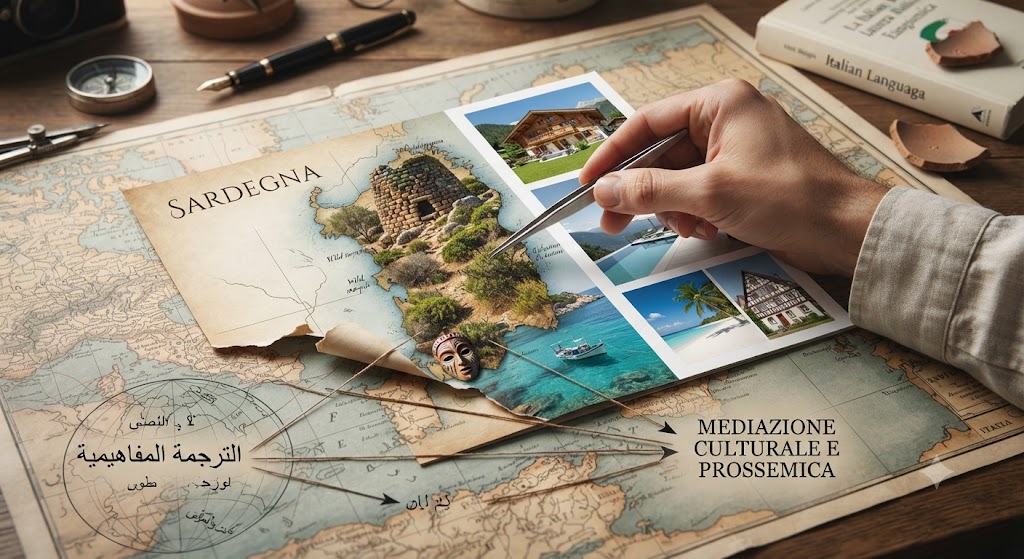
Transcoding is usually associated in language teaching with the mechanical shift from one linguistic code to another. However, if we shift this concept to the realm of semiotics, marketing, and linguistic typology, transcoding becomes the process by which a territory, a cultural identity, or a landscape is translated into a visual and promotional language tailored for a specific audience. This is precisely where the most evident limits emerge, especially when tourism promotion adopts standardized models that end up distorting local reality or clashing with deep structural barriers.
The Short Circuit Between Imagery and Perception
In the travel sector, conveying the essence of a destination requires much more than a simple transposition of evocative images. We often witness invasive tourism communication that imposes prefabricated clichés borrowed from northern or Central European contexts—fairytale forests, alpine chalets, gothic atmospheres, or luxurious minimalism—applying them uncritically to radically different settings, such as the Mediterranean or the interior areas of Sardinia. When an agency applies these foreign visual codes, a perceptual short circuit is generated for the traveler: the place is perceived as fake, slick, and distant from its pragmatic authenticity.
Linguistic Typology and Conceptual Mediation in Brochures
The challenge becomes even more complex when typological distance between linguistic systems comes into play. In tourism brochures, texts are never the result of a mechanical transfer, but rather a complex work of conceptual and pragmatic mediation. Translating complex concepts—such as the perception of beauty or proxemics in interpersonal contact—from culturally heavy idioms into other languages requires a deep semantic reconstruction:
The codification of landscape beauty: Different languages categorize territory according to unique cultural geographies. What in an Anglo-Saxon context is described with adjectives of measurability and order requires transcoding toward a historical-aesthetic and sensory dimension (harmonious, layered, suspended in time), risking the loss of the authentic link with the terroir.
Proxemics and interpersonal distance: The way a culture describes hospitality and physical closeness varies drastically. A brochure must mediate the level of familiarity and warmth (such as describing the immersion in a village festival or the cordiality of a local host) so that it appears attractive and appropriate for the cultural code of the receiving reader, avoiding misunderstandings or coldness.
The rhythm of time and spatiality: Languages influence the perception of movement. Translating an itinerary means mediating between linear conceptions and contemplative visions, preventing formal rigidity from sterilizing the value of the travel experience.
From Stereotype to Conscious Translation
The primary risk of superficial tourism transcoding is the flattening of territorial identity. A rugged landscape, a Nuragic tradition, or an authentic interior cannot be described with universal, depersonalized aesthetic or linguistic categories. Doing travel design and tourism communication today means acting as conscious cultural mediators:
Respect local and typological codes: Avoid superimposing foreign imaginaries or syntactic-conceptual structures that do not belong to the history of the place or the recipient's sensibility.
Enhance sensory specificity: Translate the travel experience through real elements—food and wine, craftsmanship, archaeology, human landscape—that speak directly to the audience's cultural code.
Build a coherent narrative: Curate the transition from the lived territory to its visual and textual narration, ensuring that the coordinated image matches the experience lived on the ground.
True tourism transcoding does not impose a prefabricated model from above, but translates the soul of a territory into an accessible, respectful language deeply rooted in its uniqueness.