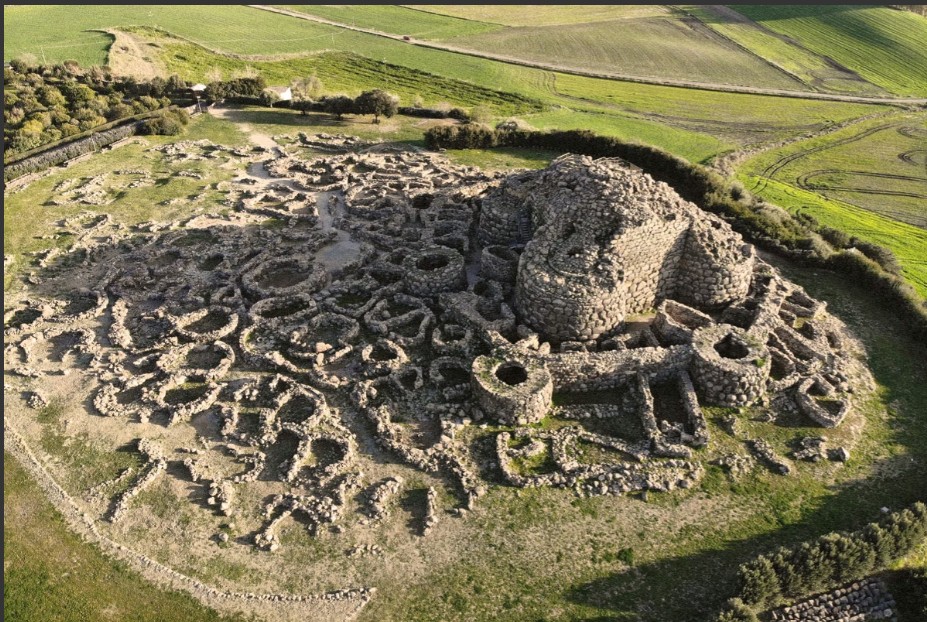
In the heart of Marmilla, in central and southern Sardinia, stands the monument symbol of nuragic civilization: About Barumini Nuraxi. Reported to light between 1950 and 1957 by the pioneering excavations of the archaeologist Giovanni Lilliu and recognized World Heritage by UNESCO in 1997, this extraordinary megalithic complex is not only a fortress, but the story carved in the basalt of over a thousand years of Bronze Age history.
The origins: the Middle Bronze and the birth of the Mastio (XVI – XV century BC)
The story of Su Nuraxi starts around 1500 BC., in full Middle Bronze, with the construction of a single truncated tower — the mastio — built using huge blocks of sprinkled basalt and overlaid, without the help of any mortar. Originally, this central tower reached almost the 19 meters high and was subdivided internally into three overlapping rooms, covered by the famous false dome tholos and connected by a helical scale obtained in the thickness of the masonry. The entrance, placed on the ground level, dominated the fertile surrounding plain, acting as a strategic control point on the territory.
The expansion of the Recent Bronze: the quadrilobed fortress (XIV – XII century BC)
With the evolution of nuragic society towards more complex and hierarchical forms of organization, the monument underwent a radical transformation during the Recent Bronze. Around the original mastius was erected an imposing Quadlobate bastion: four corner towers oriented according to the cardinal points, united by thick wall curtains that enclosed an inner courtyard with a very deep well, vital in case of siege.
At this stage, access to the ground level was walled and replaced by a raised entrance at about 7 meters high, only accessible through retractable stairs. The complex was also equipped with a second outer walls (antemurale) equipped with additional towers, transforming Su Nuraxi into a veritable fortified citadel.
The Final Bronze and the apogee of the village (XII – 9th century BC)
It is in the passage to Final Bronze that the settlement around the reggia-fortress reaches its maximum urban and social flowering. Around the walls a vast village of over two hundred huts a circular plan, made of stone with conical cover of straws and wood.
Among the houses stands the so-called Meeting room, a large circular environment with a perimeter seat in stone, niches to the walls and a lithical basin: here the clan leaders and the elders gathered to make political decisions, administer justice and celebrate rituals related to water worship. The finds found — finely decorated ceramics, bronze weapons, fusion matrices and import objects — bear witness to a dynamic community dedicated to agriculture, shepherding, metallurgy and inserted in the commercial routes of the Mediterranean.
The decline and inheritance
Towards the end of the Bronze Age and the beginning of the Iron Age (IX-VIII century B.C.), following deep social changes and perhaps traumatic events, defensive structures were partially dismantled and the village was rebuilt according to new housing schemes at the central court (the so-called huts in sectors), before the definitive punica and Roman frequentation. Today, walking between the narrow tunnels and the cyclopic stones of Su Nuraxi means physically crossing the layering of the Sardinian Bronze Age: the tangible proof of how an insular civilization has succeeded in translating its organizational force and its identity into an eternal architecture.