Abstract (English)
The present essay investigates the complex relationship between operational protocols of security and cultural awareness in the tourist sector and contemporary anthropological criticism, focusing on the thought of Ugo Fabietti. On the one hand, vocational training manuals offer guidance and forecasting grids to manage the specificities of groups of travellers from different geographical and religious contexts. On the other hand, the epistemological approach of Fabietti rejects all taxonomic rigidity and static "photography" of cultures, returning to the interlocutor the dignity of historical subject in movement. The essay explores the possible synthesis between these two perspectives, highlighting how technical and logistic competence should be based on a flexible and dialogue listening, able to overcome the stereotype without sacrificing operational safety.
Abstract (English)
This ity investigates the complex relationship between operational protocols of security and cultural awareness in the tourism sector and contemporary anthropological critique, focusing on the thought of Ugo Fabietti. On the one hand, professional training manuals provide guidance and predictive grids to manage the specific needs of travelers from different geographical and religious backgrounds. On the other hand, Fabietti's epistemological framework rejecteds taxonomic rigidity and the static "photography" of cultures, restoring to the individual the dignity of a historical subject in motion. The leiy explores the potential synthesis between these two perspectives, highlighting how technical and logisticl competence must be grounded in flexible and dialogic listening, capable of overcoming stereotypes without sacrificing operational security.
Introduction: The operational dilemma of the meeting with the Other
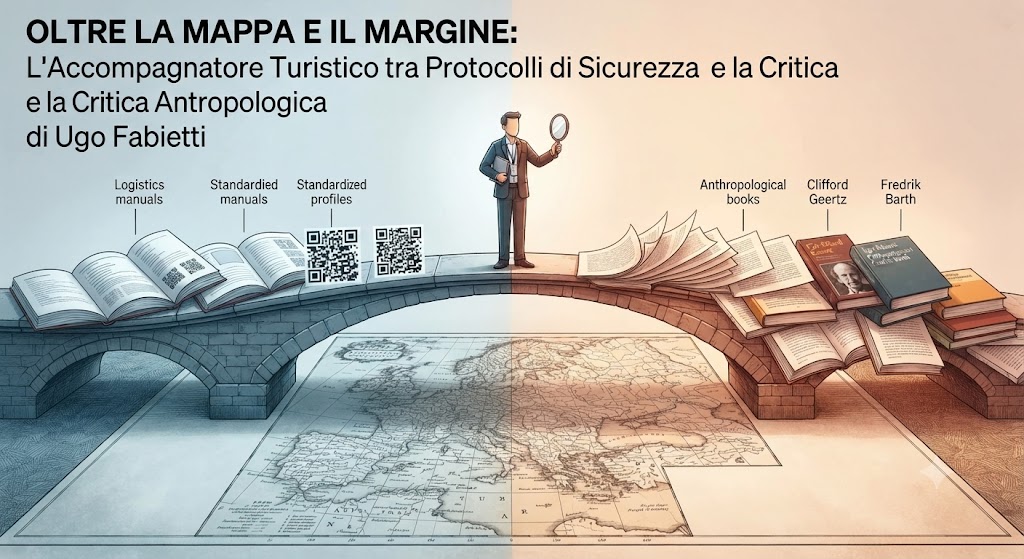
The profession of Tourist accompanier (AT) and Environmental Guide Hiking (GAE) moves daily on a thin and complex ridge: on the one hand the need to plan, predict and standardize the logistics, safety and reception of heterogeneous groups; on the other the ethical and intellectual urgency to relate with historically located human beings, irreducible to simple behavioral patterns. On the one hand we find professional training manuals, which offer reading grids, intervention protocols and national orientation profiles (American, Japanese, Indian, Arab, Chinese, Israeli). On the other hand the lesson of Ugo Fabietti and the great critical anthropology of geertzian matrix, which radically dismantled the idea of culture as a "closed can", rejecting the taxonomic temptation to freeze human groups in a static essence.
Therefore, if these two perspectives — the pragmatic one of tourist safety and the critical one of contemporary anthropology — represent two parallel lines destined to never meet, or if there is a synthesis space in which the technique of reception meets the dignity of the subject in movement.
The toolbox: The strategic value of cultural awareness in tourism
In training manuals for tourist operators, cultural awareness is not an abstract academic exercise, but a fundamental tool of Travel Security. Cultural, religious, economic and social factors significantly determine how a traveller relates to the unexpected, at the time, the space and authority of the accompanying person. The training modules focused on the art of hospitality offer operators an indispensable compass: anticipate that on certain dates American tourists could feel the nostalgia of Thanksgiving, that indian travelers will celebrate Diwali requesting vegetarian options or prayer spaces, or that during Ramadan arab visitors will module their energies and times of the meal, represents the difference between professional success and logistic failure of a tour.
This operational approach is based on prior categorization: knowing uses, customs, food taboos and festive occasions allows the accompanying person to prevent conflicts, manage criticalities with empathy and increase the overall safety of the trip. However, observed by a strictly anthropological perspective, this same need for cataloguing is likely to slip into a taxonomic trap. If we reduce the Indian tourist to a set of "technical specifications" food or the Japanese traveller to a strict stereotype of confidentiality, we run the risk of replicating that objective attitude that modern anthropology has taken decades to deconstruct.
Anthropological antithesis: Fabietti's criticism of static "photography"
This is where the setting of Ugo Fabietti breaks like a healthy and radical critical antidote. In the wake of Fredrik Barth's teaching (for which identity is not a given essence, but a continuous process of border and negotiation) and Clifford Geertz (which means culture as a densely symbolic "text" to interpret), Fabietti demolished the idea that there are "tribe" or "society" static and circumscribed.
For Fabietti the Other is never a museum repertoire, a sample to be archived or a behavioral card to be consulted before leaving. The Other is a historical subject, immersed in the tensions of its present, able to change, to adapt, to negotiate its identity and to subtract from any opener label. The error of classical anthropology — and by extension, potentially, of a massive or excessively schematic tourism — lies in assuming that a culture can be "photographed" once and for all, reducing the dynamic complexity of a human group to a series of immutable traits.
If we untransigently apply the Fabiettian criticism to the work of the tourist accompanier, each protocol of national profiling collapses under the weight of individual irreducibility: there is no "Arab tourist or "Chinese tourist, but there are individual historical subjects that, at a given time, embody or refuse certain cultural belongings according to personal, generational, social and economic dynamics.
Towards a possible synthesis: When the technique meets listening
So, these two parallel lines — operational planning of tourism security and the critical fluidity of contemporary anthropology — are really destined to never meet? At a more careful examination, the intersection space exists and is represented by the figure of the operator on the field that reflects on his practice.
The tourist guide does not do pure academic research, but moves in the urgency of practical contingency. It can not do without heuristic guidance tools (cultural maps, holiday notions, food or religious needs prediction), since the total absence of preparation would lead to a short communicative circuit and potential security risks on the territory. However, the theoretical awareness borrowed by Fabietti and Geertz acts as a fundamental ethical and epistemological corrective: it reminds the operator that the cultural grid is not an ontological cage, but a flexible working hypothesis.
The real reception professional does not use the boards on the national profiles to "tag" the passenger, but to tune their active listening tools. The technical preparation provides the cardinal points, but it is the dialogue relationship — that "to be with the other" theorized by Fabietti — that allows to seize the individual in his dynamic present. When the accompanying man knows that a Japanese traveller might conceal an discomfort behind silence, he is not applying a rigid dogma, but he is activating a hermeneutic sensibility that leaves room for the person to express himself beyond the stereotype.
Conclusions
The essay shows how technical knowledge transmitted in tourist training and the critical reflection of cultural anthropology (Ugo Fabietti) should not necessarily exclude each other. The one provides the necessary logistics and preventive safety to move around the global tourism market; the other offers the critical depth necessary to never reduce the traveller to an inanimate object to manage.
At this point of encounter lies the authentic art of hospitality: a practice in which technical competence merges with absolute respect for the subjectivity and historicity of the interlocutor, transforming every journey not in a sequence of standardized procedures, but in an authentic encounter between subjects moving in the present time