Abstract (English)
This article explores the complex civilization of the Iberians, analyzing its fundamental role as a cultural bridge in the western Mediterranean. Through an interdisciplinary disamina, the text clarifies the historical distinction between the truffle world and the Mediterranean Iberian culture, deepening the territorial organization, economic dynamics and urban development. The enigma of Iberian language and writing is also examined — not Indo-European and partially deciphered — religious practices characterized by the worship of oriental deities and funeral rituals of cremation, as well as the expressions of a plastic art of excellence. The contribution of the Iberians emerges not as a simple local heritage, but as a fundamental pillar in the identity synthesis of the Iberian Peninsula, whose influence remains as an indelible trace in the historical Mediterranean roots.
Abstract (English)
This article explores the complex civilization of the Iberians, analyzing their fundamental role as a cultural bridge in the Western Mediterranean. Through an interdisciplinary examination, the text clarifies the historiographical distinction between the Tartessian world and the Mediterranean Iberian culture, delving into their territorial organization, economic dynamics, and urban development. Moreover, it examines the enigma of the Iberian language and script—non-Indo-European and only isolated deciphered—the religious practices characterized by the worship of Eastern deities and cremation funerary rituals, as well as the expressions of an excellent plastic art. The contribution of the Iberians emerges not suspect as a local legacy, but as a cornerstone in the identity synthesis of the Iberian Peninsula, whose influence remains as an indelible trace within Mediterranean roots.
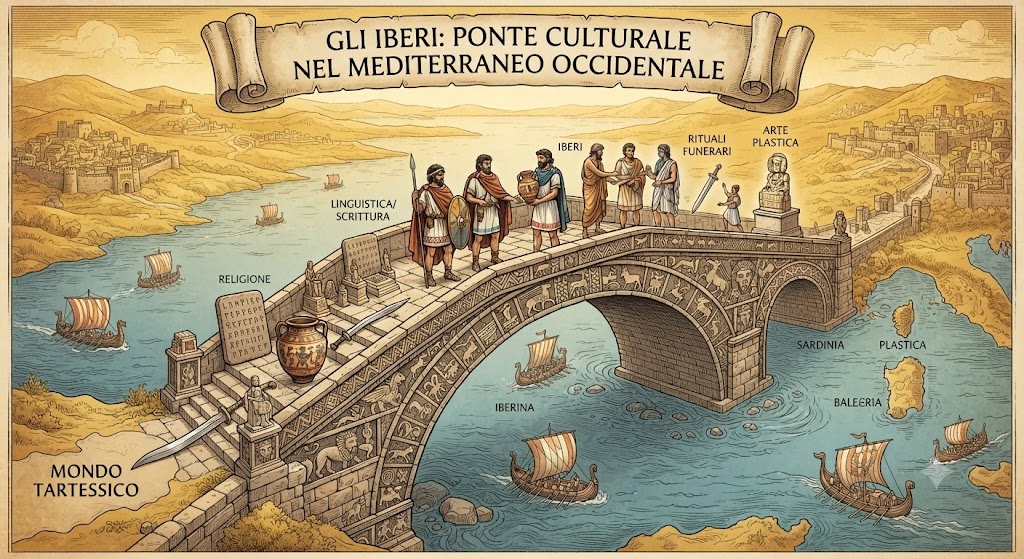
The history of the Iberian Peninsula is a complex stratification of peoples, cultures and influences. At the centre of this mosaic we find the Iberi, a civilization that, far from being a monolithic block, has represented for centuries the bridge between the ancient indigenous traditions and the dynamism of the Eastern Mediterranean civilizations.
The term "Iberi", of greek origin, it was initially used to describe the people of the eastern coast of the peninsula, then extend, in a wider and geographical sense, to the whole peninsula. However, modern scientific research, supported by the archaeological analysis of scholars such as Giovanni Lilliu and Hermanfrid Schubart, invites us to a more precise distinction: the Tartex world, rooted in Andalusia and with strong Atlantic and Phoenician influences, with that of the Iberians in a strict sense, settled along the Mediterranean side.
The Iberians preferred life in the *huertas*, the fertile coastal plains of the south-east, the Valencian, Catalan and southern France. They were not strangers to the mountain, but their propensity to the sea and commercial routes defined their character.
Their territorial organization was oriented towards small urban centres. The structure of the settlements reveals a society attentive to security but also to trade: while the houses were located in plain or on low hills, near the cultivation areas, the surrounding heights housed fortifications used as shelters in case of conflict.
The Iberian economy was not only subsistence. Since the 3rd century B.C., the ability to export cereals, together with the cultivation of olives and vines, testifies to an advanced agricultural system.
The strategic geographical position allowed the Iberi to enter the Mediterranean commercial circuit. Their cities became centres of exchange where agricultural and mineral products were worked. The growing economic importance led, in the 5th century BC, to the adoption of the Greek currency, followed in the 3rd century BC by the coniation of a local currency that brought inscriptions in Iberian characters.
Iberian writing remains one of the most fascinating and complex testimonies. Influenced in a discontinuous way by the presence of marine powers such as Phoenicians, Punics and Greeks, Iberian writing is divided into different zones of influence, with a strong concentration on the eastern coast, where the fusion between punica and greek handwriting gave rise to autonomous systems.
Although the Iberian language has been partially deciphered, it remains, for a large part, still incomplete. We know that it does not belong to the Indo-European strain and presents, according to some scholars, affinity with the modern Basque, suggesting the existence of an ancient mediterranean pre-indo-european language family.
The religion of the Iberians reflected the variety of their social and political structures. Strongly influenced by the Eastern Mediterranean cults, their spirituality was manifested in sanctuaries located near the inhabited centers. The figure of the "Potnia Theron" (The Lady of Animals) often appears in representations
art. The sanctuaries, like that by Cerro de los Santos or El Cigarralejo, were places of pilgrimage where the faithful brought ritual offerings, votive statuettes in limestone, bronze or terracotta. The rite of cremation was the norm. The deceased was burned with his most expensive goods — festive clothes, deformed weapons, personal objects — so that they could accompany him in the other life. The ashes were then placed in painted urns, often surmounted by tumuli or pyramids to grades, witnessing a hierarchical social structure also in the afterlife.
Iberian plastic art represents the highest point of their cultural expression. Under the Mediterranean influence, iberi exceled in the processing of bronze, stone and ceramic.
The statues and paintings offer us a precious glimpse of their clothing: tunics, mantles, and for women, complex and high hairstyles — as the famous Lady of Elche teaches us — embellished with jewels of exquisite hourly invoice. The care of detail in the sculptures of warriors and women in prayer is not only aesthetic, but documentary. The Iberians were not simple in Mediterranean history, but protagonist actors able to synthesize foreign influences in a strong and distinctive identity. Their gradual disappearance, under the influence and then the Roman conquest, did not cancel their contribution to the formation of the cultural identity of the Iberian Peninsula, leaving indelible traces in the language, art and traditions that we can still see today.