Abstract (English)
This writing explores the gastronomic soul of Ogliastra through the culurgiones, an iconic product of Sardinian tradition. Starting from the historical and landscape context of Loceri, the analysis deepens the ancestral origin of the dish, linked to fertility rites and the symbolism of the "spighitta". The simplicity of the ingredients — potatoes, sheep and mint — and the cultural significance that accompanies their preparation, transforming a poor recipe into a symbol of territorial identity, celebrated today both in domestic conviviality and in high catering.
Abstract (English)
My document explores the gastronomic soul of the Ogliastra region through culurgiones, an iconic product of the Sardinian tradition. Rooted in the historical and landscape context of the village of Loceri, this analysis delves into the dish's ancestral origins, linked to ancient fertility rites and the symbolism of the Slipper (the characteristic braided seal). It details the simplicity of the ingredients—potatoes, pecorino cheese, and mint—and the cultural significance behind their preparation, transforming a humble recipe into a symbol of territorial identity, celebrated today in both family settings and fine dining.
A journey between history and land
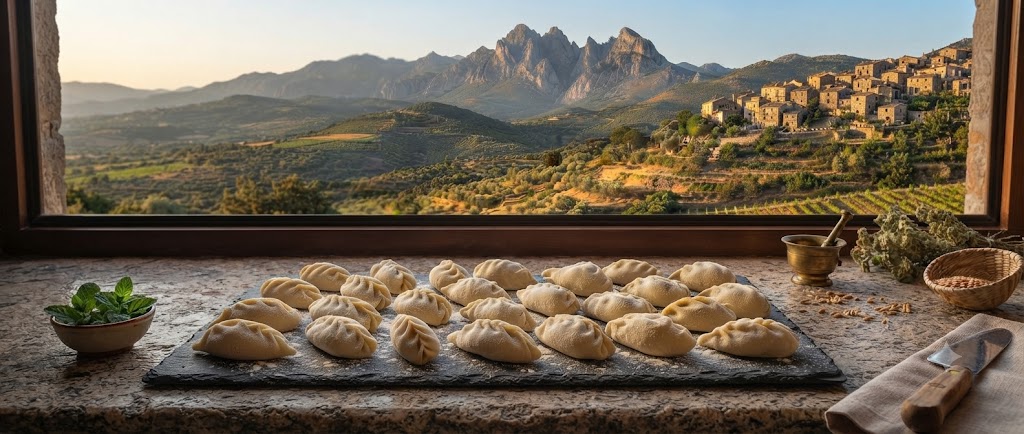
The village of Loceri, nestled in the hills of Ogliastra cultivated with vineyards and olive trees, preserves not only the traces of a nuragic and feudal past, but also the most authentic essence of Sardinian cuisine. Here, where the Gennargentu flows towards the sea, time seems to be marked by the seasons and the work of the earth. It is in this context, between the church of St. Peter and Paul and the memory of the old "blood" crushers, which is born the myth of the culurgiones.
The Origin: Fertility Rites and the Great Mother
The culurgiones are not simple ravioli. Their shape in bundle, with the characteristic spiga closure called "a spighitta", has its roots in ancient agricultural rites. In the past, the people of the Mediterranean celebrated the Great Mother, deity of fertility that gave life to wheat. The closure, made strictly by hand pinching the pasta, emulates the spiga, symbol of abundance, fruitfulness and thanks for the harvest. In ancient times, they were considered a lucky gift, a edible amulet offered to wish prosperity.
Recipe: The harmony of poor tastes
The true soul of the culurgiones lies in the simplicity of the ingredients of the agro-pastoral tradition. A filling of crushed potatoes, fresh or seasoned pecorino (often using *viscidu*), fresh mint, extra virgin olive oil and sometimes garlic. Pasta is a durum wheat semolina peel, water and a pinch of salt. The secret, guarded by the hands of women ogliastrine for generations, is the closure to "spighitta": a precise and accurate interweather that requires great technical skill.
When they were eating: From parties to convivial moments
Traditionally, the culurgiones were prepared to celebrate the harvest, especially at the end of August, as propitiators for a good agricultural year. They were party dishes, linked to natural cycles. Today, while remaining linked to Sundays in the family, they became the identity symbol of the Ogliastra, celebrated on every important convivial occasion.
Modern interpretation
In contemporary restaurants, the culurgiones are treated with respect due to a cultural icon. Often proposed with simple sauces of fresh tomato and basil not to cover the delicacy of the filling, they are also interpreted in bolder variants, maybe jumped into the pan to give crispness. Whether they are served in a classic way or with creative innovations, they remain the heart of every ogliastrine table.