Abstract (English)
This reflection analyses the evolution of the concept of accessible tourism, overcoming the obsolete vision that confines it to a mere regulatory obligation or a charitable gesture. Accessibility is here redefined as a fundamental pillar of tourism excellence and quality of service, able to meet the needs of an extremely varied user — from people with disabilities to families with children, to elderly people and travellers with food restrictions. Through the analysis of the current structural and cultural criticalities of the Italian system, the article supports the need for a systemic approach that integrates the reception at every stage of the tourist industry. Finally, it is stated that the adoption of high standards of autonomy and respect for the traveller represents not only an act of civilization, but an indispensable strategic lever for the competitiveness and global relaunch of the destination Italy.
Abstract (English)
This ity analyzes the evolution of the concept of accessible tourism, moving beyond the outdated view that limits it to a mere regulatory obligation or a charitable gesture. Accessibility is redefined here as a fundamental pillar of tourism excellence and service quality, capable of meeting the needs of an extremely diverse user base — from people with disabilities and families with children, to the elderly and travelers with dietary restrictions. By analyzing the current structural and cultural criticalities of the Italian system, the article argues for the necessity of a systemic approach that integratis accessibility into every stage of the tourism supply chain. In conclusion, it is stated that the adoption of high standards of respect and respect for the traveler represents not only an act of civilization but an essential strategic lever for the competitiveness and the global revival of Italy as a tourism destination.
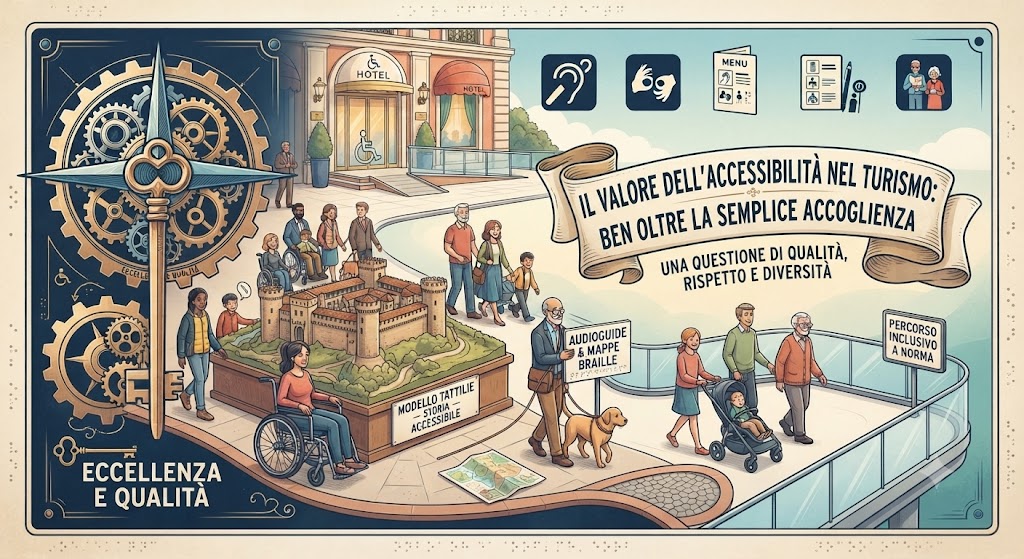
The concept of tourism is experiencing a profound transformation, necessary and indispensable. Often the idea of "accessibility" a regulatory obligation or a gesture of benevolence towards a specific category of people. Nothing further from reality. Real accessibility is a question of excellence, quality of service and, above all, respect for human diversity that characterizes every potential traveler.
Who are the protagonists of this market? It is not just people with motor, sensory or cognitive disabilities. The audience that requires specific attention is incredibly wide: we think of those suffering from celiac disease or other intolerances, to those who have to follow strict dietary regimes, to the elderly, to people with cardiopathy, to parents who move with bulky strollers. Each of these travelers expresses a need that, if satisfied, transforms a frustrating experience into an unforgettable stay. A disabled tourist, first of all, is a tourist. He does not seek mercy, nor paternalistic assistance: he seeks the opportunity to enjoy his time, to travel independently, to find services that really work.
Our country, even though it is one of the most popular destinations in the world, still suffers from structural and cultural barriers. Railway stations, menus written with tiny and unreadable characters, hotels that refuse entry to guide dogs – despite the laws in force – are just a few examples of a system that must make a qualitative leap. It is not enough that a structure is "standard"; the entire supply chain – from transport to catering, from museums to communication – is designed to be hospitable.
The challenge is to transform awareness into action. To educate tourist operators, administrations and entrepreneurs means to understand that accessibility is a key to reading for the competitive relaunch of Italy. When a place becomes accessible, it becomes easier and enjoyable for everyone. It is a collective benefit that expands the user basin, improves the image of the destination and raises the general quality standard.
To welcome does not mean "to do a favor", but to offer professionalism. It means adopting a natural attitude, speaking directly to the person and not to his companion, being available without being intrusive. It means understanding that the time of the other is precious and that punctuality is a form of respect. Accessibility, ultimately, is the parameter by which we measure the degree of civilization of a tourist offer. Are we ready to build a tourism where diversity is no longer an obstacle, but a valuable resource to enrich everyone's experience? The answer lies in our ability to design, listen and finally act with professional intelligence.
Sources used:
- Reference document: "New turismi, are we ready? "
- Additional information from: FIABA (Fondo Italiano Abbattimento Barriere Architettoniche) – www.fiaba.org