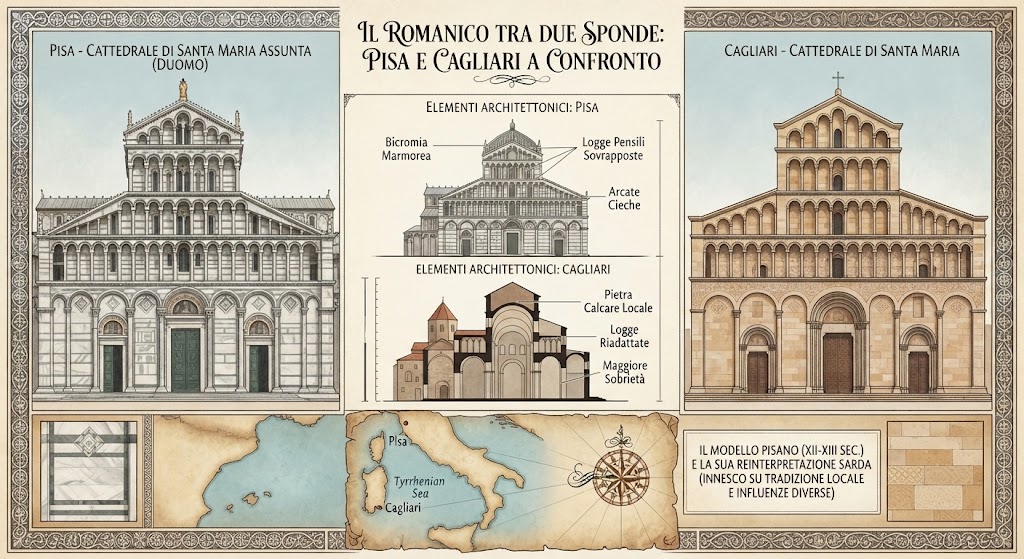
Romanesque architecture is one of the most fascinating pages of medieval history, serving as a "bridge" between classical heritage and Middle Age innovations. In this panorama, the Romanesque pisano occupies a prominent place, fruit of the power of the Marinara Republic of Pisa, able to absorb Byzantine, Islamic and Armenian influences, re-elaborating them in a monumental and refined language.
When this aesthetic was "exported" in Sardinia, he met a different reality, creating a unique architectural dialogue, of which the Cathedral of Santa Maria Assunta in Cagliari is the most complex witness.
The Pisa model: the aesthetic code
The Romanic Pisan, perfected between the 11th and 12th centuries, stands out for some key elements that define its identity:
The bicromy, that is the alternating use of white and dark marbles to create horizontal bands, a sign of social distinction and wealth
The visual lightness, obtained through the systematic use of blind arches and, above all, of hanging loggias that give a sense of three-dimensionality and rhythm to the facades.
Decorative geometries, with the integration of lozenges and inlays of Islamic and Armenian inspiration that make the facades similar to fine stone carpets.
The Cathedral of Cagliari: a layered "stone book"
The Cathedral of Santa Maria in Cagliari is not a "pure" and intact specimen of Romanico, but a living organism that reflects the tormented history of the island. Founded by the Pisani around 1217 and elevated to the cathedral in 1258, its original structure followed the Pisan spatial rigor, with a Latin cross plant and three aisles.
However, unlike the homogeneity and stylistic purity of the Cathedral of Pisa — built with precious marmi variopinti —, the building of Cagliari is deeply stratified. Its evolution is a continuous dialogue between styles: the original lines have overlapped the imposing Gothic-Catholic chapels, the splendor of the Baroque and, last but not least, the neo-Romanic face that today welcomes visitors. The present facade, in fact, is not the original medieval one (demoted in the past centuries), but was rebuilt in 1933 using the most austere and opaque limestone of the Bonaria Hill, in an attempt to return to the church its original historical dignity.
Similarities and contact points
Despite the deep differences in materials and constructive events, the link with the Tuscan motherland is indelible and manifests itself in different ways:
The space system: The internal structure preserves that spatial rigor that the Pisans imposed on Sardinian religious buildings, a constant reminder to the model of the cathedral of origin.
The sculptural treasure: The tangible proof of Pisan excellence in Cagliari is kept inside of the Cathedral, two pulpits by Guglielmo da Pisa (1159-1162). These masterpieces, transported from Tuscany in the 14th century, represent the direct connection and the purest example of Pisan Romanesque art present on the island.
The desire for medieval identity: The same reconstruction of the facade in the twentieth century shows how the Pisan model is perceived as the historical identity "ideal" of the cathedral, pushing the designers to recover the styles of the cynical arches and the typical tripartition of Tuscany.
While the Cathedral of Pisa remains the maximum expression of a marine power that wanted to amaze the Mediterranean with shining marbles, the Cathedral of Cagliari is the story of a Sardinia that has absorbed, reinterpreted and often dressed in other dresses — such as those of the Gothic-Aragonese or the Baroque — that original Tuscan imprint. Visiting Santa Maria means not only going in search of the Romanic, but reading Cagliari's extraordinary ability to be a crossroads of different cultures and ages.