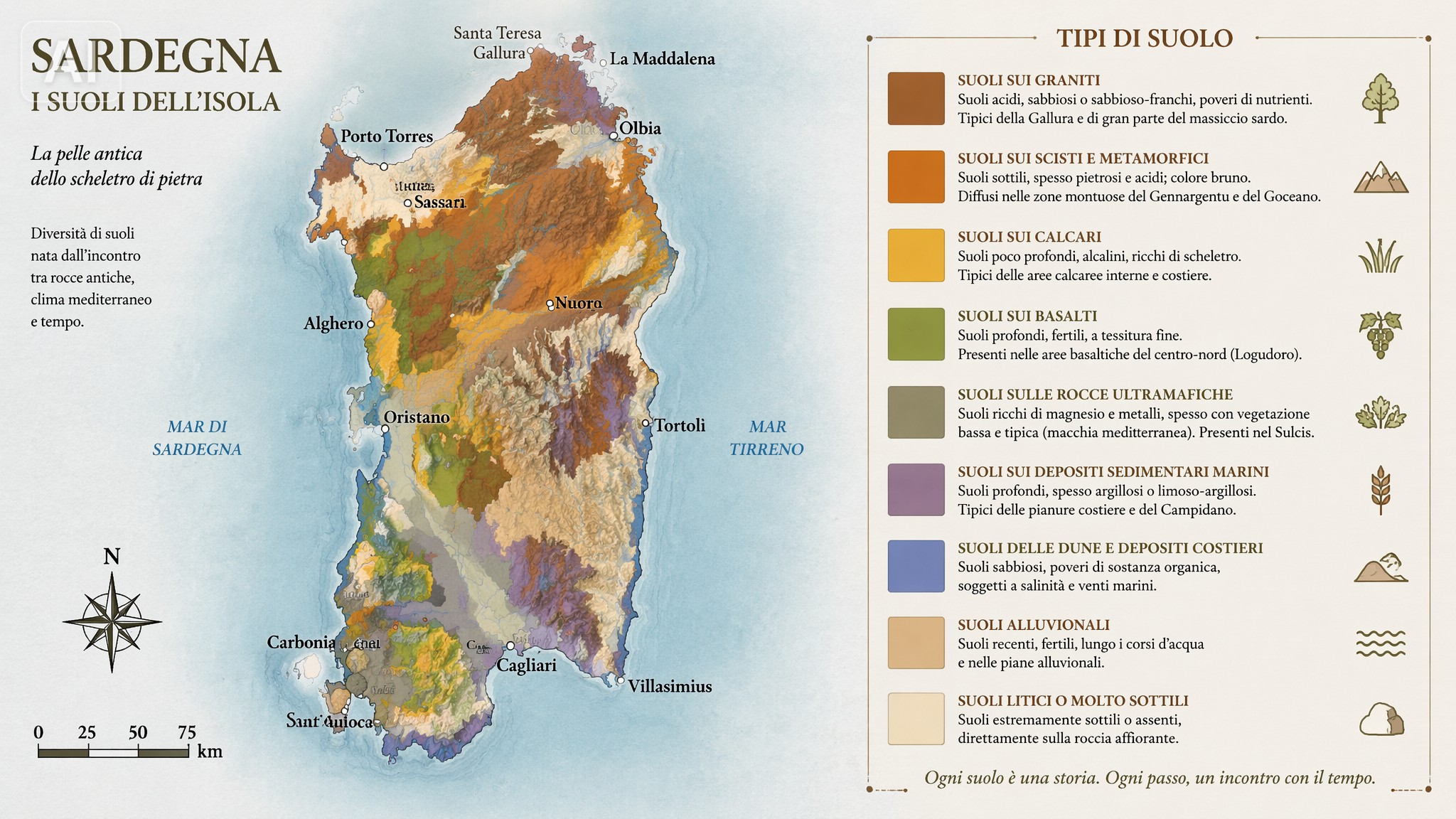
Abstract (IT): A geological and emotional journey through the soils of Sardinia, the "skin" of a vagrant island born half a billion years ago. From the paleozoic and cenozoic history of detachment from the European block to the extraordinary variety of soils: from the white calcareous coral reefs and the red earth of Supramonte, to the volcanic oxydiana of Monte Arci, from the granitic soils of Gallura to the lunatic basalts of the Giare. A slow tour to walk consciously on the memory of the earth.
Abstract: A geological and emotional journey through the soils of Sardinia, the "skin" of a wandering island born half a billion years ago. From the Paleozoic and Cenozoic history of its detachment from the European block to an extraordinary variety of terrains: from the white limestone reefs and red soils of Supramonte, to the volcanoc obsidian of Monte Arci, the granitic soils of Gallura, and the moody basalt plateaus of the Giare. A slow-tourism path to walk consciously upon the memory of the earth.
If the mountains are the skeleton of Sardinia, the soil is its skin: a thin, precious and incredibly ancient veil that tells us how life has adapted to rocks born half a billion years ago. For me that I accompany people on a slow pace through the paths of our island, the land is never "only land"; it is the result of a magical encounter between stone, rain and time.
When I drive travelers through Sardinia, I often notice how the landscape changes face in a few kilometers. But to really understand the strength and the extraordinary diversity of this micro-continent, i always invite you to take a step back in time, to listen to the story of your birth.
The Vagabonda Island: How Sardinia was born
The story I love to tell begins in the Paleozoic, over 500 million years ago. At the beginning of time, Italy we know today did not even exist, and Sardinia was firmly established attached to the european continental block, enclosed between Provence and Spain.
South, where today the plains of the Campidano and the reliefs of the Sulcis-Iglesiente extend, there was an ancient calm and shallow ocean. In this tropical sea they have deposited for millions of years sands, shells of marine organisms and very small sediments: this is where they have formed the oldest rocks in Italy.
About 300 million years ago, a colossal collision between continents – the Ercinic Hormony – he has curled the earth's crust, raising massive mountains, merging the granite in the heart of the earth and transforming the sediments into the skies that today slip away under our shoes on the peaks of Gennargentu.
But the real magic happened later in the Cenozoic Era (between 30 and 15 million years ago). Under the push of huge tectonic forces, sardinia has literally detached itself from the crust of the European continent. Like a big stone raft, it started a slow rotation counterclockwise in the Mediterranean Sea, to reach the current position. During this lonely journey, the earth split, opening the gigantic wound of Fossa del Campidano and awakening volcanoes that have forever changed the face of the island.
The Mosaic of the Sisters: Calpesting History
All this movement has created a variety of unique lands in the world. Every soil of Sardinia has a voice, a texture and a color that comes directly from that long geological journey.
The Chalk soils: The memory of the Tropical Sea
Moving east, between the white walls of the Supramonte or along the profiles of the Ogliastra Heels, we walk on what remains of those ancient mesozoic coral reefs. The limestone soils have a dramatic relationship with water. The rock below is a karst sponge, full of cracks and caves that swallow the rain instantly, leaving the arid surface.
In dolines and small depressions, however, I always point out the accumulation of the famous Red Land. It is not dust brought by the wind, but the insoluble residue (a clay and oxides of iron, practically rust) remained after the rain dissolved limestone for millennia. In front of this contrast, I use a powerful image: "This red fire is the mineral essence left to witness the missing tropical sea".
The Black Gold of Monte Arci: Oxydiana
There is a soil in the oristanese that shines in a special way under the sunlight: it is the land that surrounds the Monte Arci. During the great volcanic fractures of the Cenozoic, the magma rich in silica has escaped and cooled so quickly that it does not have time to form crystals, turning into volcanic glass: oxydiana.
In the soils of this area, mixed with dark earth, there are glossy, sharp and black fragments like the night. When I drive a group in these places, I like to remember that we are trampling the first major commercial resource of prehistoric Sardinia, a precious stone that has attracted sailors from all over the Mediterranean since the Neolithic.
The Powder of the Stars: The soils of the Granite
In the areas where the ancient ercinic magma was trapped under the ground and then emerge thanks to erosion, as in Gallura or Monte Linas, the landscape becomes harsh. The granite over time is crumbled under the action of the elements, turning into a coarse and crisp sand we call gris.
These soils are acidic and drain the rain water quickly, washing away nutrients. It is the undisputed kingdom of cork. I'll tell the travellers this way: "You are trampling the deep heart of a volcano that has never managed to erupt, cooled 300 million years ago in the bowels of the earth". I Sounds that Breathe: The Yellow Basal
On the Giare, the soil is born from basalt, a black and fluid lava deposited by much more recent volcanoes (about 3 million years ago). These lands have a decidedly lunatic character. In winter they become heavy and waterproof as a clay to model, holding water in temporary ponds we call Paulis. In the summer, under the scorching sun, the clay is contracted and split into deep cracks. I often explain the earth is closing down, sealing its intimacy to protect deep moisture from summer heat.
Every time I drive a path along the paths of Sardinia, I try to convey this awareness: we're not just hiking. We are walking on the back of an ancient giant, a vagrant island that crossed the sea and which brings with it, in the color and texture of its soils, the deep secret of half a billion years of history. Switch from a cold technical description to a living and emotional narrative is, for me, the only way to turn a trip into a truly unforgettable experience.