Abstract (IT): A thousand-year journey into the sacred relationship between man and rock in Sardinia, where stone is never inert material but a living creature. From the original purity of menhirs to the universal worship of the Goddess Mother — speculate to figures like Isis and Cibele —, passing through fertility rites and popular lithotherapy, up to the Christianization of the places and the myth of the Domus de Janas.
Abstract: A millennium-long journey into the sacred relationship between humanity and rock in Sardinia, where stone is never inert material but a living creature. From the pristine purity of menhirs to the universal cult of the Earth Mother — mirroring figures like Isis and Cybele —, passing through fertility rites and popular lithotherapy, down to the Christianization of ancient sites and the myth of the Domus de Janas.
What is a stone for us today? Little more than inert material. But if we walk through the paths and archaeological sites of Sardinia, we immediately realize that for our ancestors the rock was a living creature, an eternity anchor and the primordial channel to touch the divine. There is an invisible thread that unites the mysticism of our megalithic monuments to universal devotion to Mother Earth, in a history of prehistoric Sardinia that cleans, unbroken, for thirty thousand years.
The pristine rock and the chisel that "viola" nature
The sacredness of raw and untouched stone is a universal concept, even present in the sacred texts of the Middle East. In the biblical books of Exodus and Deuteronomy a precise command is read:
"If you build me a stone altar, do not do it with cut stones; for if you use the chisel on the stone, you make it count.".
For the ancients, the stone created by nature already possessed divine perfection. Changing it with iron meant violating it. It is the same philosophy that led thesardinian archaeology of stone: our great menhir sardi (perdas fittas) were not overwhelmed by the action of man, but chosen and raised in their majestic purity to preserve intact their spiritual and vivifying strength.
The cult of the Goddess Mother: from Sardinia to the global archetype
Long before modern religions imagined divinity as a father, humanity worshiped a Mother, and Sardinia was one of the most extraordinary sanctuaries of this devotion. In Paleolithic and Neolithic, the miracle of birth made the female body the first true temple. The statues found throughout the island —the wonderful Sardinian Venus with generous breasts and belly— testify to the centrality of the worship of the Goddess Mother.
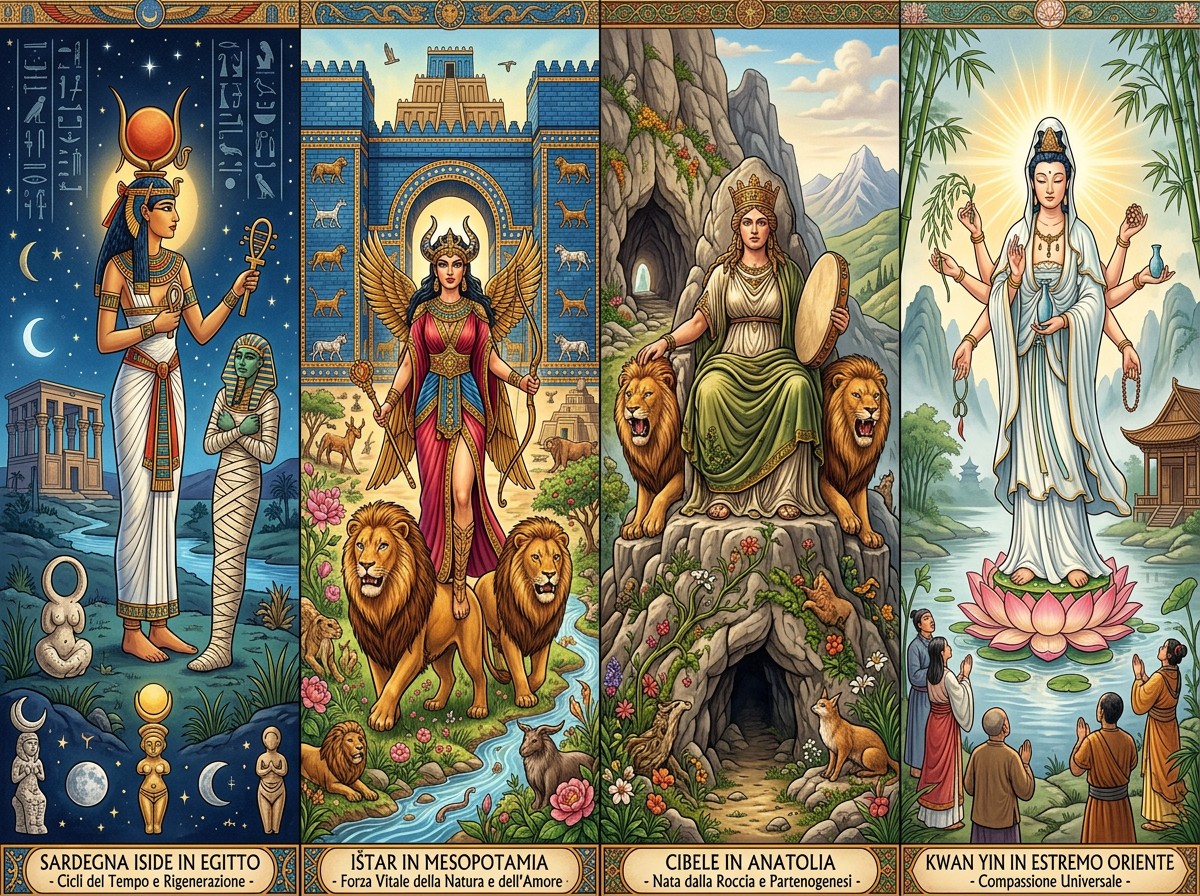
The archaeologist Marija Gimbutas has shown that this archetype of the "Prime Women's Divine" was global, and every civilization gave it a name and a specific symbol:
Isis in Egypt, linked to the cycles of time and regeneration.
Ishtar in Mesopotamia, the vital force of nature and love.
Cibele in Anatolia, the goddess born from the hard rock, able to generate life alone (partnogenesis).
Kwan Yin in the Far East, expression of universal compassion.
In this atlas of the sacred, Sardinia was the heart of a Mediterranean mysticism that saw in the rock the very uterus of the earth.
Lithotherapy and popular medicine: the healing power of Perdas Fittas
This deep bond with stone was not abstract philosophy, but everyday life and popular medicine, a practice that scholars call lithotherapy (care through the stones). While in ancient Greece the historian Pausania remembered that crude rocks were worshipped, in the Sardinian tradition this mysticism arrived alive until the last century.
Women who could not have children were looking for big menhirs, like the famous monolith of Cucuru Tundu, and they rubbed your belly to ask for the gift of fertility or childbirth without pain. Shatic patients sought contact with sacred rocks, and weak children were made to pass through the natural cracks of perforated stones to "reborn" healthy. Touching the Sardinian rock meant absorbing the immortal strength of the Mother.
The sacred camouflage: from the Domus de Janas to the Virgin Mary
With the arrival of Christianity, the Church tried to erase these pagan traditions. There are strict laws of the year 789 A.D., signed by Charlemagne, which harshly condemn those who worship stones and trees. But the memory of the Sardinian land is stubborn.
He could not destroy the sacredness of the places, he applied a "sacred disguise". The old altars dedicated to the autonomy of the Mother Goddess were consecrated to the Virgin Mary. That is why many of our sanctuaries campestri —places of extraordinary devotion still today — are born exactly over ancient megalithic sites and prehistoric settlements.
And the ancient priestess, the guardians of the rock? In popular folklore they hid to survive, becoming the legendary protagonists of Domus de Janas in Sardinia. The fairies that tradition wants them to count their treasures and weave their gold threads right inside the rooms carved into the stone.
When we travel to Sardinia today and caress these rocks, we are not just looking at archaeology. We are looking at a story of love and respect between the human being and the Earth that has lasted for thirty thousand years. Names change, religions evolve, but the spirit of stone remains eternal.