Abstract
The article explores the Sardinian fedina, an iconic jewelry of traditional goldsmiths that combines craftsmanship with a deep symbolic and cultural value. The unmistakable "bee nest" or grain processing is analyzed, a technique of micro-fusion and filigree that recalls the wheat ears, an ancient symbol of prosperity and fruitfulness in the agropastoral culture of the island. The text describes in detail the phases of manual processing in the workshop — from the preparation of the basic truth and geometric creation to the complex welding on fire and finishing — highlighting the patience and skill handed down by the master goldsmiths. Finally, the article deepens the historical meaning of the jewel, born as a pledge of eternal love, promise of official engagement and tangible sign of identity and community membership.
Abstract in English
The article explores the Sardinian wedding band (Sardinian fedina), an iconic piece of traditional jewelry that combines master craftsmanship with symbolic and cultural value. It examines the characteristic honeycomb (honeycomb) or granular technique, a micro-casting and filigree method that echoes the wheat ear, an ancient symbol of integrity and fertility in the island's agropastoral culture. The text details the manual workshop processes—ranging from the preparation of the base ring and geometric creation to complex torch soldering and finishing—highlighting the patience and skills passed down by master goldsmiths. Finally, the article delves into the importance of the jewel, originally gifted as a pledge of eternal love, an official engagement promised, and a meaningful sign of identity and community belonging.
There is a detail that often captures the look of those traveling in Sardinia: the hands of people, and in particular the fingers adorned by complex, three-dimensional rings, which seem small embroidery of precious metal. We don't talk about simple jewelry, but about real fragments of wearable history. In Sardinia, the traditional goldsmith is never only ornamentation: it is an ancient language made of symbols, protection and belonging.
Among the most fascinating jewels of the island tradition, Sardinian fedina Takes a place of honor. But what is the story behind this iconic ring?
Tradition plot: honeycomb processing
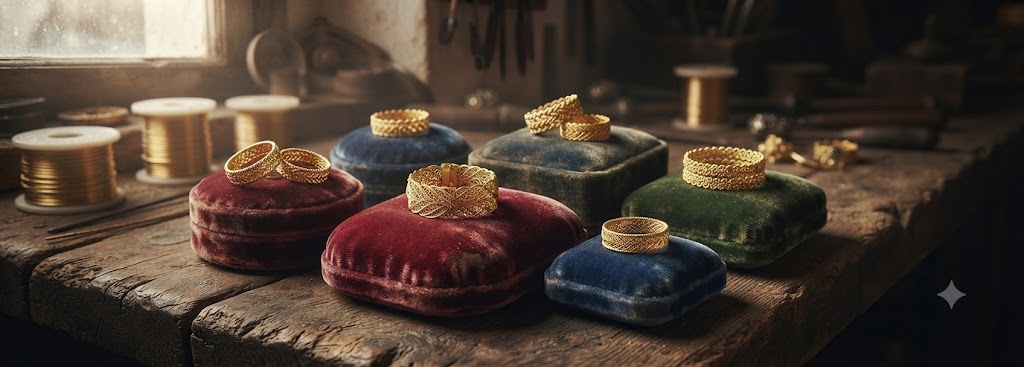
The main feature of the traditional Sardinian record is its unmistakable honeycomb (or grain), obtained through the ancient technique of melting and welding of tiny gold or silver spheres. This geometric design so dense is not casual: in the Sardinian agropastoral symbolism, the texture recalls the shape of the ready wheat ears for harvesting, an ancient wish for prosperity, abundance and fruitfulness.
Looking at a Sardinian faith means observing a masterpiece of micro-fusion and filigree, a technical heritage that master goldsmiths hand down from generation to generation, adapting the workshops of the past to the needs of contemporary design.
To fully understand the value of a Sardinian faith, you have to enter a traditional goldsmith shop and look closely at the stages of its work, a meticulous process that requires a great manual skill and a dummy patience. Although today technology offers modern tools, Sardinian goldsmiths continue to hand down assembly and assembly techniques that transform a simple thread or a foil (gold or silver) into a three-dimensional embroidery.
- The thread and the foil: It all starts from the fusion of the precious metal, which is pulled to create thin threads or laminate to form the circular structure of the ring (the truth).
- The measure: The loin is cut and welded with millimetre precision to fit perfectly to the finger size, acting as a solid spine on which the entire geometric design will develop.
The creation of the "Nido d'Ape" (Granulazione e Filigrana)
This is the most iconic and complex phase, the one that requires the firmest hand:
- The lozenges design: On the surface of the ring is first welded a lozenges or honeycomb structure composed of very thin braided gold wires (the filigree), which create a series of tiny empty geometric cells.
- The grain: Inside each of these cells a microscopic metal ball (grain) is inserted. The grains are arranged one by one with the help of precision tweezers and welded at the base. It is this "fashioned" or thick grain effect that, in addition to recalling the wheat ears symbol of prosperity, gives the fedina that characteristic three-dimensional relief that captures light.
Fire welding
- Alloy and heat: The critical phase of assembly is welding. The otopus uses a special micro-flame and welding powder to permanently fix hundreds of microscopic contact points without the excessive heat bases or spoils the delicate structure of the watermark and the grains.
Finishing and burning (or cleaning)
- Chemical and mechanical cleaning: Once the hot assembly is completed, the ring is immersed in special solutions (decoupling) to eliminate the oxidation residues of the welding.
- The final details: The ring is finished with fine files and brushes. If you work silver, you often proceed to a slight browning (controlled oxidation) of the inner parts to make the three-dimensional geometry of the honeycomb stand out, making the design even deeper and sharper.
The meaning: a pledge of love and identity
Historically, the Sardinian faith was given on solemn occasions, as a promise of eternal love or as an official engagement ring. It was the tangible symbol of a bond that, just like the thick metal texture, could not be broken. In a world where every island community jealously guarded its stylistic variants, wearing this ring also meant to declare its identity and respect for the roots of its own land.